
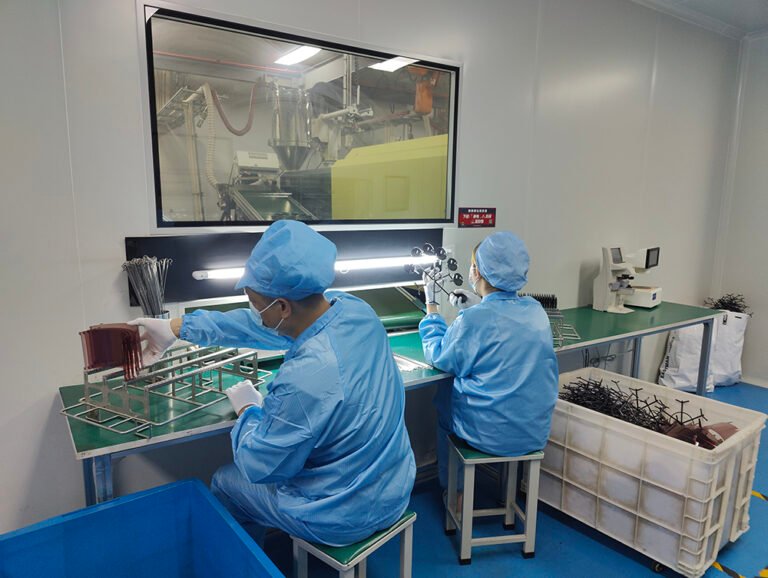
Importing eyewear is not just about choosing a design or negotiating a price. In reality, many quality problems only appear during bulk production — not in samples.
Small defects such as loose hinges, coating failure, or surface imperfections can lead to returns, delays, and even damage to your brand reputation.
Understanding where these issues come from — and how to prevent them — is essential when working with eyewear manufacturers.
1. Lens Coating Problems
Lens coating issues are one of the most common and most critical problems in eyewear production.
Common issues include:
- Poor transparency (not clear enough)
- Coating cracking or peeling
- Coating fading over time
These problems are often caused by low-quality coating processes or poor adhesion between layers.
A key industry reality:
Not all coatings are the same. There is a big difference between real coating and imitation coating, both in cost and performance.
For example:
- Certain colors, such as pink or light fashion tints, require real coating
- If imitation coating is used, the color can fade very quickly
Another critical factor:
Coating thickness.
Thicker coating is not always better.
If the process is not well controlled, thicker coatings are more likely to crack.
Maintaining a thin, stable, and clear coating requires proper technology and process control.
In bulk production:
Coating issues often do not appear in samples, but become obvious in large quantities.
2. Lens & Frame Fit Issues
Another common problem is poor fitting between the lens and the frame.
Typical issues:
- Lens not fitting tightly
- Light leakage around the rim
- Stress during assembly
This usually comes from:
- Inaccurate mold size
- Poor tolerance control
- Assembly inconsistency
In some cases, improper fitting can even cause stress cracks or long-term deformation.
3. Surface & Appearance Defects
Visual quality is extremely important in eyewear.
Common defects:
- Frame surface pitting (small dots or rough texture)
- Scratches on lenses
- Uneven finishing
These issues are often caused by:
- Poor polishing
- Contamination during production
- Improper handling or packaging
Surface defects are highly visible and directly affect customer perception.
4. Hinge and Structure Problems
Hinge problems are one of the most frequent complaints from customers.
Common issues:
- Loose hinges
- Uneven opening force
- Misalignment
In many cases, the problem is not only the hinge itself, but also:
- Screw quality
- Assembly accuracy
Even a small component like a screw can cause long-term issues if not properly controlled.
5. Metal Plating Quality Issues
For metal frames, plating quality varies significantly depending on cost.
Common problems:
- Color inconsistency
- Peeling or fading
- Uneven surface finish
These issues are directly related to plating level and process control.
In most cases, lower price means lower plating quality.
6. Material & Cost Misunderstandings
One of the biggest misunderstandings among buyers is:
The same design should have the same price.
In reality:
- The same style can be produced at very different quality levels
- Material selection affects durability and performance
- Coating type and process significantly affect cost
- Even small design changes can increase production difficulty and price
Understanding these differences is key to avoiding quality issues.
7. What Happens in Bulk Production
A common mistake is assuming:
If the sample is good, the bulk will also be good.
In reality, bulk production introduces new challenges:
- Material variation between batches
- Process stability issues
- Assembly consistency
For example:
- Coating problems
- Hinge performance
- Plating quality
These issues are much more likely to appear in large-scale production.
8. Quality Control: Frames and Lenses Are Different
One important point that is often overlooked:
Frame inspection and lens inspection should not be treated the same.
They require different control methods.
Frame inspection focuses on:
- Surface quality (smoothness, no sharp edges)
- Structure alignment
- Assembly quality
Lens inspection is more complex:
- Coating performance
- Optical clarity
- Internal stability
In practice, effective quality control usually includes:
- Semi-finished inspection (before painting and assembly)
- Final product inspection
- Laboratory testing for coating performance
- Sampling checks during early production
- 100% visual inspection for appearance
This multi-stage approach helps reduce risks before shipment.
Final Thoughts
Quality issues in eyewear are rarely caused by a single factor. They are usually the result of material choices, process control, and production experience.
From a manufacturing perspective, controlling quality is not just about inspection — it is about understanding where problems are likely to happen and preventing them early.
If you are importing eyewear, focusing only on price can lead to higher risks later. A better approach is to evaluate materials, processes, and production capability together to ensure consistent quality in bulk orders.
The End
Thank you very much for your reading.